
Invoke Bio is using AI to learn how tumors evolve under pressure from the immune system and identify the targets most likely to matter. Born from research that helped deliver personalized cancer vaccines, Invoke has already treated five patients.
By Ruhani Chhabra
At the center of Invoke Bio’s approach is a deceptively difficult question: Which parts of a patient’s tumor should a personalized cancer vaccine teach the immune system to attack?
When patients with cancer began approaching Timothy “TJ” Sears and his lab at UC San Diego, they weren’t simply asking about the team’s research. They wanted to know if it could help them.
The lab had spent years improving algorithms used to design personalized cancer vaccines, which train a patient’s immune system to recognize features specific to their tumor. In collaboration with other academic institutions, the team eventually designed personalized vaccines for three patients who received them through the FDA’s expanded access program. Two remain in remission today.
“I was so struck by the unmet need these patients were facing that I felt obligated to try and bring our AI models directly to them,” TJ says.
Invoke Bio aims to change how those vaccines are designed by replacing a process that has historically relied heavily on human judgment with one informed by how tumors evolve under pressure from the immune system.
TJ had seen the limitations of the traditional approach firsthand. Selecting which tumor targets, or neoantigens, to include in a vaccine could mean gathering physicians around an Excel spreadsheet to debate which appeared most promising.
“We literally would sit on these 20-person physician Zoom calls and argue over an Excel spreadsheet to choose the ‘targets’ that would be loaded into the vaccine,” TJ says.
Invoke takes a different approach. Its AI model learns from the history of interaction between tumors and the immune system, looking for clues about which targets the immune system can recognize and which a tumor has learned to hide.
“We decided to treat the immune system like a black box, and ask it directly, ‘What can you actually see—and why?’” TJ says.
The approach caught the attention of Brian Atwood, who advises TJ through QB3’s mentoring program. After reviewing Invoke’s early data, Atwood asked a longtime friend and cancer vaccine expert to take a look at the company’s work.
“His first comment to me was, ‘Brian, this is going to work,’” Brian says. “I signed up to help TJ then and there.”
For Brian, Invoke represents what he describes as a rare convergence of the right founder, scientific training, emerging technology and timing. “That lucky convergence of the right entrepreneur, training, available tools and fortuitous timing is always a hallmark of great companies,” he says.
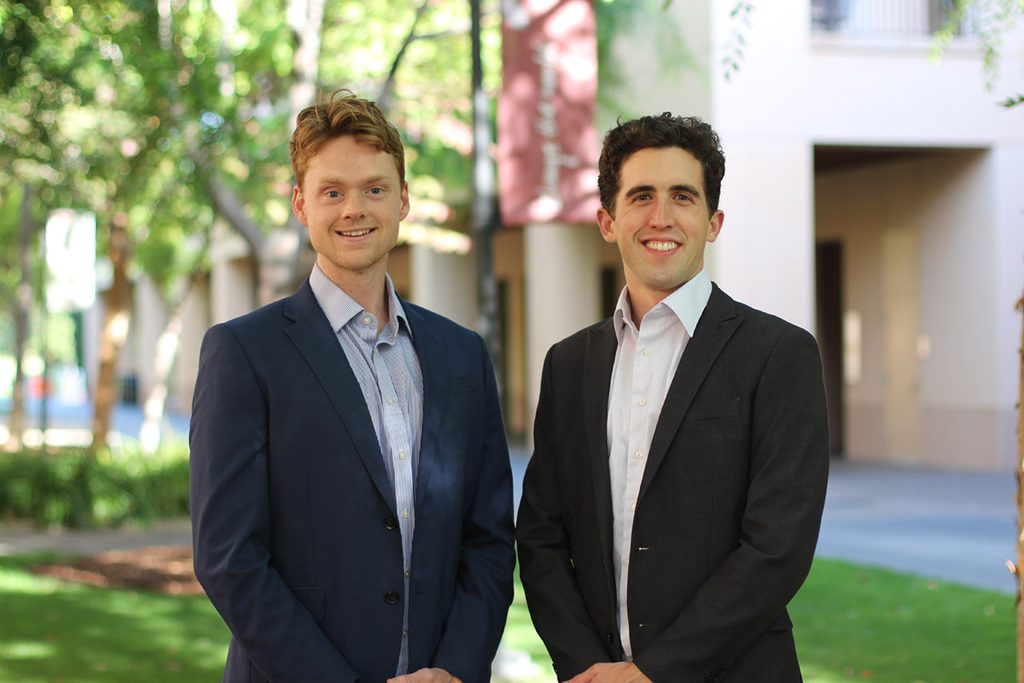
TJ teamed up with Luke Forsthoefel to bring the technology out of academia and closer to patients. Luke had previously advised biotech and biopharma companies before attending Stanford Graduate School of Business.
“Helping these companies launch therapeutic products for several rare diseases gave me the desire to move from advisor to operator,” Luke says.
A chance encounter between the two at Coupa Cafe in Stanford helped set the foundation for Invoke Bio. As the company took shape, TJ found QB3 through word of mouth and connected with Kaspar and Katarina Klett, who encouraged the team to apply.
A $100K QB3 award has since helped accelerate Invoke’s research with TJ’s UC San Diego lab, supporting computational resources, R&D staff, patient sample collection and improvements to its model. But TJ says one of QB3’s greatest benefits has been its community of founders.
“It can be kind of a crazy, weird and sometimes lonely journey,” TJ says. “Having other people that you’re not competing with, but are just kind of on a similar track to you, is amazing.”
Invoke raised a pre-seed round in March and plans to close its seed round this fall. Within the next year, the team hopes to establish an Invoke-sponsored expanded access protocol as it works toward a formal clinical development program and, ultimately, making personalized cancer vaccines accessible to more patients.