Spencer Seiler spent years building tiny automated laboratories capable of growing and studying millions of human neurons. Now, he’s pairing that technology with AI—and with help from QB3, turning years of academic research into a neuroscience tools company.
By Ruhani Chhabra
Meet Spencer and Open Culture
Before Spencer Seiler became the co-founder and CEO of Open Culture, he was a physicist.
After studying physics and plasmonics, a field of nanotechnology, Seiler worked at several Bay Area startups, including Berkeley Lights and Ultima Genomics. Seeing scientists turn ambitious technologies into companies convinced him that he eventually wanted to build one himself.
That ambition led Seiler to UC Santa Cruz, where he was drawn to the work of Professor David Haussler, a global leader in genomics, and an environment that brought biology, computation, and engineering together. Here, Seiler worked on the engineering side of neuroscience.
That work eventually produced the technology at the center of Open Culture: “the Habitat.”
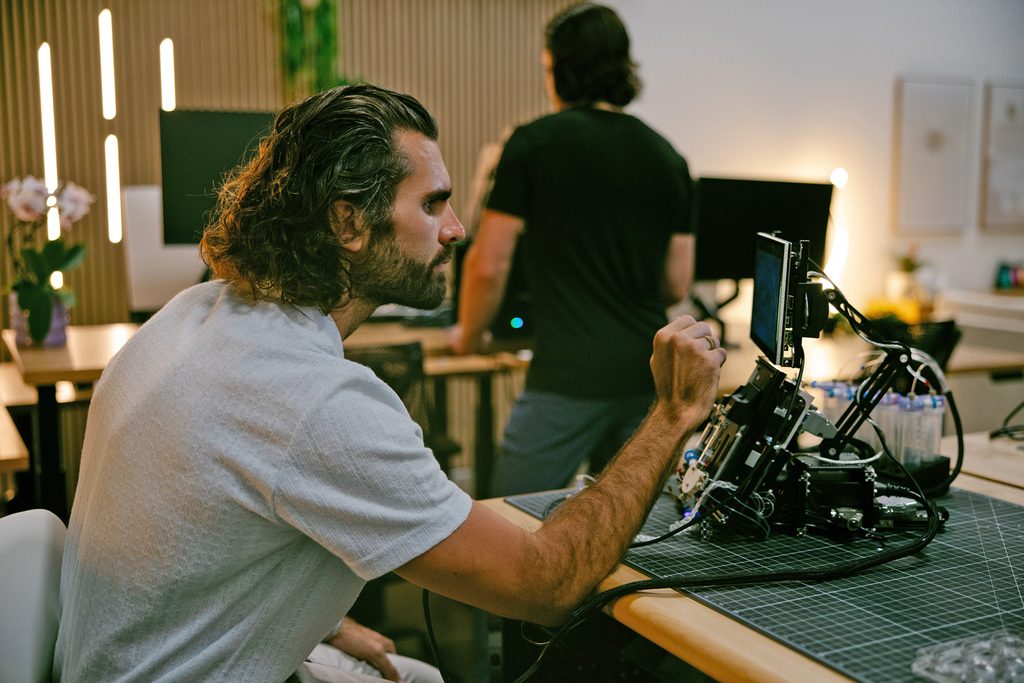
The Habitat is a miniature automated stem cell laboratory capable of growing millions of human neurons. Researchers can send signals to the neurons and receive signals back, allowing them to study living, functional neural networks.
Initially, the Habitat was an academic research tool. But other scientists quickly wanted access.
Seiler built the devices by hand, eventually producing around 14 during his time in academia. Some were deployed to researchers around the country, including at UCSF and in Chicago. As more requests arrived, the team realized demand was becoming more than an academic lab could sustain.
“There’s a pull, and that’s the market,” Seiler says. “When you feel like the world is pulling your products out, that’s when to productize.”
Seiler and his collaborators spun the technology out of UC Santa Cruz and formed Open Culture.
Bringing AI back to neuroscience
Open Culture emerged just as increasingly capable AI agents were beginning to transform scientific research.
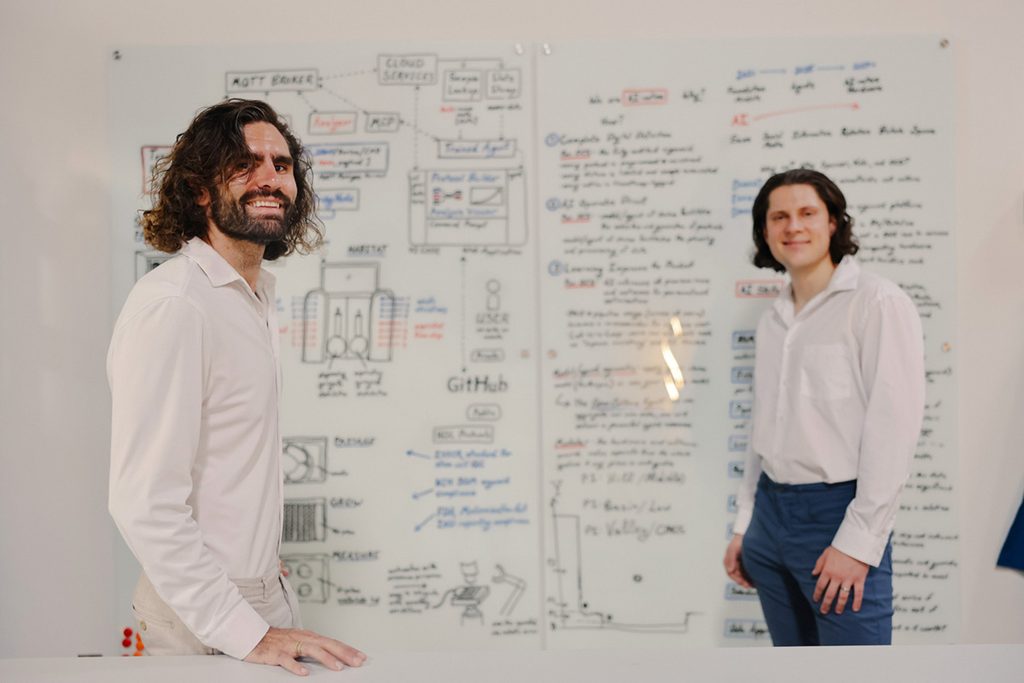
Because the Habitat was already automated, Seiler and his team saw an opportunity to integrate AI into the research process. Today, the company is developing technology that can help scientists program experiments, analyze results and interpret neuroscience data.
This approach is described as “human in the lead, AI empowered.” Seiler compares it to a power tool: the scientist is still doing the work, but the right technology can allow them to accomplish dramatically more.
One UCSF neurosurgeon working with Open Culture captured that potential after using the technology, claiming that they did two months of work in one night.
Alongside the Habitat, Open Culture has launched an agentic analysis platform for neuroscience research. At the time of the interview, Seiler said the platform had more than 50 active users across over 30 organizations.
There is a certain symmetry to what Open Culture is building. Artificial neural networks were originally inspired by scientists studying biological neurons.
Now, Seiler wants to use AI to help scientists better understand the biological systems that inspired it.
“What is the origin of thought? What is the origin of ‘I’?” Seiler says. “All of these things are completely unanswered.”
From academic technology to company
By the time Open Culture connected with QB3, the team had already spent years developing its technology. What it needed was help thinking about that technology as a business.
Through QB3’s early stage mentoring program, Seiler was paired with Widya Mulyasasmita, Ph.D., a GP and co-founder of the firm BEVC. Her background was particularly relevant to Open Culture Science: Mulyasasmita brought both an investor’s perspective and experience with scientific tools companies.
“She really helped us reposition to think about economies, markets, users, and even our trajectory through fundraising,” Seiler says.
“What drew me to Open Culture was their technical depth, creativity, and founder drive,” Mulyasasmita says. “Hardware, AI, and cell culture are converging in ways that could transform neuroscience. Open Culture has the engineering instincts to see what’s possible and the passion to build it. They’re a delight to work with: receptive to feedback and fast at translating insights into progress, from technology to business models and partnerships. Their collaborative spirit makes them a natural fit for QB3, and as a tools company, they’re uniquely positioned to give back by helping others in the community.”
For Open Culture, her insight in the sector was a vital distinction. The company was not developing its own therapeutic or performing research as a service. It was building tools—physical devices and software platforms—that other scientists could use to conduct their own research.
Mulyasasmita helped the team think through what that meant for its users, market and growth strategy. She also helped deepen Open Culture’s connection with the broader QB3 community as the company considered where to establish its next home.
Finding a home at Bakar Bio Labs
As Open Culture searched for laboratory space, the team considered multiple Bay Area incubators. Bakar Bio Labs ultimately stood out for something that aligned closely with the company’s own philosophy: collaboration.
“Bakar won me over from the heartfelt, alive ecosystem,” Seiler says. “We felt love from day one.”
Seiler saw that culture in practice when another company no longer needed a microscope worth several thousand dollars. The Bakar team connected the equipment with Open Culture.
For a company founded around the idea that scientists can accomplish more by sharing tools and working together, the environment felt like a natural fit. Bakar’s proximity to UC Berkeley also gives the young company access to scientific talent as it begins building its team.
Now, Open Culture is bringing its technology into Bakar while expanding a platform already reaching neuroscientists beyond the Bay Area.
The company began because researchers were pulling a new neuroscience tool out of the academic lab faster than Seiler could build it. Open Culture wants to bring AI back to the field that helped inspire it, and give neuroscientists new tools to investigate some of the brain’s biggest unanswered questions.
Does your story mirror Spencer’s? Looking for guidance on early stage company creation or development? Reach out to QB3’s Innovation Discovery and Early-Stage Mentoring!